/> ShareJunction - Member Posts
logo transparent gif
top_white_spacer
Home Latest Stock Forum Topics MyCorner - Personal Stocks Porfolio Stock Lists Investor Insights Investor Research & Links Dynamic Stock Charting FREE Registration About Us top spacer top spacer
 User Password Auto-Login
Enter Stock
 
righttip
branding

Back

Latest Posts By ozone2002 - Supreme      About ozone2002
First   < Newer   4541-4560 of 7452   Older>   Last  

12-Jan-2010 11:10 Others   /   GIC lost on NY property       Go to Message
x 0
x 0
rule no 1 to making big bucks : be greedy when others are fearful...
Good Post  Bad Post 
12-Jan-2010 10:05 Others   /   GIC lost on NY property       Go to Message
x 0
x 0
contribute more CPF!.. oh yeah!
Good Post  Bad Post 
12-Jan-2010 09:15 AusGroup   /   AUSGROUP: 1H09 revenue up 28.8% to reach A$260.5 m       Go to Message
x 0
x 0


i won't panic for now..

 
Good Post  Bad Post 
12-Jan-2010 09:05 AusGroup   /   AUSGROUP: 1H09 revenue up 28.8% to reach A$260.5 m       Go to Message
x 0
x 0


ausgrp got whacked!.. from 73 to 675..

 
Good Post  Bad Post 
12-Jan-2010 08:52 Straits Times Index   /   STI to cross 3000 boosted by long-term investors       Go to Message
x 0
x 0


Minister Lim hng kiang said no double dip recession..

WHACK THE stock market!.. keke
Good Post  Bad Post 
11-Jan-2010 17:48 China New Town   /   ChinaNTown       Go to Message
x 0
x 0


today's vol is massive..

i saw big lots being thrown to the buyer..

8K, 3K etc..

wonder who's the seller n more importantly who's the buyer..
Good Post  Bad Post 
11-Jan-2010 11:36 China New Town   /   ChinaNTown       Go to Message
x 0
x 0


loh weng whye inside don't have to worry..

advisor to temasek lei..

anyway the 15c sell Q seems like an impossible task..
Good Post  Bad Post 
11-Jan-2010 11:29 AusGroup   /   AUSGROUP: 1H09 revenue up 28.8% to reach A$260.5 m       Go to Message
x 0
x 0


if u look at the chart, ausgrp was down on low vol..

near term resistance 74.5, next is 79..
Good Post  Bad Post 
11-Jan-2010 10:50 China New Town   /   ChinaNTown       Go to Message
x 0
x 0


NAV 16c..

should go for dual listing.. cos i whack a lot on this baby..haha
Good Post  Bad Post 
11-Jan-2010 10:42 PSC Corporation   /   Do you know why?       Go to Message
x 0
x 0


price chiong over thin vol..

can be easily manipulated..
Good Post  Bad Post 
11-Jan-2010 10:16 China New Town   /   ChinaNTown       Go to Message
x 0
x 0
so hot today? will halt today? keke
Good Post  Bad Post 
11-Jan-2010 09:35 Citic Envirotech   /   United Envirotech       Go to Message
x 0
x 0

0.35!! broken!!!!


tedlim_me      ( Date: 06-Jan-2010 13:20) Posted:

waiting!

ozone2002      ( Date: 06-Jan-2010 13:11) Posted:


gotta break 34.5 to fly


Good Post  Bad Post 
10-Jan-2010 19:16 $ AdvSys   /   ADV SYS AUTO       Go to Message
x 1
x 0
Which Is Better, IPO Or RTO?


During good economic times, initial public offerings (IPOs) normally are able to garner a higher offer price and assured of an over subscription. However, in the current financial crisis, listing aspirants are finding it harder to obtain funding for their shares. Reverse takeovers (RTOs) were popular during 2007 to 2008. However, since the introduction of Catalist, RTOs appear to be falling in numbers. There are those who feel that the relative ease of listing on Catalist would sound the death knell for RTOs. Given a choice, which is better? An IPO or a RTO?

IPO Can Be Expensive
Private companies go through the strict and rigorous task of preparing for an IPO in order to access the capital market, unlock shareholders’ value and boost the company’s image. Listing through an IPO allows the company to sell new shares to the public, receive funding as working capital and to fund acquisition of other businesses. The amount raised can vary depending on the number of new shares and share price offered.

What many investors don’t realise is that to conduct an IPO can be quite expensive. Referring to the 2009-listed companies discussed in issue 362, Westminster Travel raised approximately $7.1m from its listing where approximately $1.7m went into listing expenses excluding vendor share sales (see table). This made up close to 24% of the total amount raised. However, this was little compared to Japan Foods Holding’s listing expenses which accounted for 48.1% of total funds raised!

When comparing the funds raised against the listing fees, it does not make sense for a company to get listed. This may differ for companies listing on the Main Board. Soon-to-be-listed Main Board company PEC is expecting to raise $25.2m from its public offering and share placement, of which approximately $4m of the gross proceeds is for listing expenses. This translates to about 16.1% of the total proceeds raised. It seems that listing is more expensive for Catalist companies than Main Board enlistees when comparing listing expenses in proportion to proceeds.

Why Do A RTO?
What we have discussed earlier is to allow investors to understand that a listing is not cheap, the final proceeds received from the listing may only be enough for the company to pay for part of its equipment costs. This is part of the reason why reverse takeovers (RTOs) occur. Some companies don’t wish to spend unnecessary money on listing expenses thus RTOs are often a much cheaper option.

A RTO route has often been regarded by market observers as an option undertaken by a “dying” listed shell company and a privately-held company looking for a backdoor listing. The shell company would acquire a large shareholding in the privately held company by issuing substantial amount of new shares as payment. In return, the shareholders of the privately held company gains majority control of the new company. Under SGX regulations, the minimum price that has to be offered for the new shares is $0.20/share.

The advantages of public trading status include savings on underwriter costs as a RTO does not require the appointment of an underwriter. Going public through a RTO allows a privately held company to become publicly held with less stock dilution than through an IPO as the company can go public without raising additional funds. It could choose to offer new shares for working capital at a later period. Some private companies also provide profit guarantees to the shell company as a pre-requisite for the number of shares issued to them, adjustable when earnings are realised.

The process for an IPO can be tedious and long. However, the availability of a listed shell company alleviates the time consuming process on the new owners since the shell company is already in compliance with the rules of the listing manual. Companies that sold their core business such as Novena Holdings and Maveric provide opportunities for RTOs while loss-making companies require a new injection of funds to re-ignite their business.

Catalist listed electronic components trader Gates Electronics has received in-principal approval from the Singapore Exchange to acquire China Dongyuan Environment in a $105m RTO deal. It will be renamed China Environment upon completion of the RTO, joining the list of S-chips in Singapore. China Dongyuan Group is a provider of waste gas treatment solutions in PRC.

Although the introduction of the Catalist has significantly trimmed down the time required for a company to get listed from the former Sesdaq period of five – six weeks, a RTO is expected to be completed in an even shorter time since most of the pre-requisites for listing are already found in the shell company. Also, a Catalist listing requires a sponsor, which some companies would want to bypass and opt to list on the Main Board instead.

Conclusion
At the end of the day, a RTO provides much more benefits than listing through an IPO. However, there may be commercial reasons for private companies to go for an IPO rather than a RTO as the latter can be rather messy if disagreements happen between the shell company and private company. Nonetheless, the jury is still out.
Good Post  Bad Post 
10-Jan-2010 18:58 $ AdvSys   /   ADV SYS AUTO       Go to Message
x 0
x 0


RTO is bad  news only when it doesn't materialise..

to name a few

1) Rowsley

2) Oculus

Successful RTOs include that charlie boom town :

1) wilmar via ezhealth

2) oceanus via oceanus biotec

3) china environment etc etc..

 
Good Post  Bad Post 
10-Jan-2010 09:27 $ AdvSys   /   ADV SYS AUTO       Go to Message
x 0
x 0
RTO!!congrats to those who have this stock
ASA to buy Chinese textile firm Thinkgreat

It'll sell its current business producing semiconductor equipment to ASTI Holdings


By CHEW XIANG


CATALIST-listed Advanced Systems Automation (ASA) yesterday said it will be buying a Chinese fabric maker and selling its present business producing semiconductor equipment to controlling shareholders ASTI Holdings.


Thinkgreat Investments, a textile business which will now be listed through the reverse takeover, will cost $5 million in cash and $260 million in 928.6 million new shares at 28 cents apiece, ASA said.

The deal will also see ASTI - which now owns 39 per cent of the company - capitalising some $19 million in outstanding loans owed to it by ASA into new shares. Another $8.6 million in outstanding loans will be set off as consideration for businesses that ASTI is buying.

ASA will also raise further capital by undertaking a two-for-five rights issue, with a detachable warrants issue, and also issue $25 million in one per cent notes to an investment fund.

The one cent per share rights issue could raise $19.4 million with the detachable warrants, issued at two-for-five rights issue shares, raising another $3.9 million if fully exercised.

After the rights and warrants issue, divestment and notes placement, the shares will undergo a 15-to-1 consolidation before the issue of new shares to acquire Thinkgreat.

ASA said the reverse takeover was in the best interests of the company as the outlook for its business 'is increasingly challenging in the current economic climate'.

The company could find it difficult to get finance to operate efficiently and to sustain the business, ASA said. 'The directors are of the view that the proposed acquisition offers an opportunity to acquire a profitable business in the textile industry which would likely enhance shareholder value.'

Thinkgreat's most recent unaudited results show a net profit of 121 million yuan (S$24.7 million) for the year ended Dec 31, 2008, on sales of 612.3 million yuan. The present Chinese vendors will own more than half the post-acquisition company following the deal.

The deal is dependent on satisfactory due diligence, and regulatory and shareholder approvals for the entire package.

For the third quarter to Sept 30, ASA lost $1.5 million on sales of $3.2 million. Over the nine-month period, losses came to $5.3 million on sales of $9.7 million, about half the $19.8 million in sales achieved for the same period the previous year.

Trading in the stock has been halted since Wednesday and will resume Monday morning.

Good Post  Bad Post 
10-Jan-2010 08:37 Straits Times Index   /   STI to cross 3000 boosted by long-term investors       Go to Message
x 0
x 0

2010: The Best of Times or the Worst?


by Robert Kiyosaki
Posted on Tuesday, December 29, 2009, 12:00AM


“It was the best of times. It was the worst of times.” 
­ – Charles Dickens

Is the recession over? Are happy days really here again? Paraphrasing Dickens, my answer is, “For people who are prepared, 2010 will be the best of times. For many, 2010 will be the worst of times.”

The following are a few of my predictions and reasons behind them…

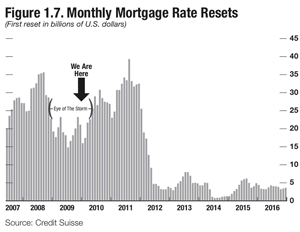
Prediction #1The real estate market will crash again.chart5.gif

Pictured above is a graph of mortgage resets. In simple terms, a mortgage reset is when a mortgage comes due. In normal times, refinancing was a simple process…but these are not normal times. Some points of interest:

1.  In September 2008, the mortgage resets hit $35 billion that month. That was the exact time the financial crisis hit. When people could not afford to refinance and began to default, the stock market and banking industry crashed. 

2.  The eye of the storm: In the summer of 2009 mortgage resets were low -- around $15 billion a month. This is when optimists began to see “green shoots” in the economy. The green shoots were the eye of the storm.  In 2010, as I see it, the second half of the financial hurricane hits. By late 2011, the resets climb to nearly $40 billion a month. The storm will not end until 2012.

3.  The first half of the storm was primarily due to subprime defaults. The second half of the storm will hit more solid homeowners. The question is, can they weather the storm? Will Mac Mansion foreclosures be next?

4.  In America, there are over 40 million people who own more than two homes. Can they afford to carry and refinance two or more mortgages?

5.  Since home values have gone down, many homeowners will find they owe more than their home(s) are worth. Will the bank be kind to them?

6.  The time for using your home as an ATM is over. This is crushing retailers and retail real estate. Shopping centers are in trouble. Strip malls are empyting as shopkeepers close -- permanently. This will lead to the crash of the office, warehouse, and other commercial properties.

My prediction:  Obviously these are the best of times if you are a buyer of distressed properties and the worst of times if you are a seller.

Other things I am watching for in 2010:

1. Will China crash? America’s crash has hit China in the gut. The Chinese are laying off millions of workers. Only massive government bailout is keeping the economy afloat. The Chinese boom will eventually go bust…but will it bust in 2010? Only time will tell.

2.  When America stopped importing from China, China stopped importing from the rest of the world. This affects Asian countries as well as Australia, Brazil, and other suppliers of raw materials.

3.  Fed Chairman Ben Bernanke is replacing toxic debt with new debt. By protecting his friends in the mega-banks, he is turning the U.S. into a zombie nation. The recession is over, but America is entering an era we will be calling The New Depression, a period when the rich become extremely rich but everyone else becomes poorer. Taxes will kill anyone working for a paycheck.

4.  The U.S. dollar will grow weaker. If the dollar strengthens, we will have more unemployment because our goods become too expensive and we will export less. 

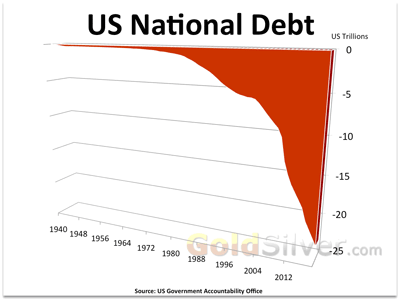
5.  The deficit will increase.  The bailouts for the rich are killing the economy. Chart6.gif

6.  Israel may attack Iran. Israel will not tolerate Iran developing nuclear power, even if Iran claims it is for peaceful purposes. If there is an attack, oil prices will go through the roof. 

7.  Dead cat bounce. The current stock market rally will probably turn into a dead cat bounce. If the Dow drops below 6500, 5,000 may be the next stop.

The Best of Times

I know I sound painfully pessimistic. I know my predictions are bad news for most people. Yet, for others, bad news is good news.

The following are the bright spots for people who are prepared.

Prediction #2: Gold, silver, and oil will continue to be safe investments in 2010.

The following recaps the year-end prices of gold and silver:

            YEAR             GOLD                                    SILVER
            2000               $  273                         $  4.57
            2001               $  279                         $  4.57
            2002               $  348                         $  4.78                       
            2003               $  416                         $  5.92
            2004               $  438                         $  6.79
            2005               $  518                         $  8.80
            2006               $  638                        $12.78
            2007               $  838                        $14.77
            2008               $  882                        $11.33
            2009              $1100  (approx)     $17.50  (approx)

In 2009, the Dow rose approximately 18%. Gold rose approximately 25%. Silver rose approximately 50%. 

By the end of 2010, I predict gold will be at $1,775 an ounce, silver at $24 an ounce, and oil at $85 a barrel. If Israel attacks Iran, these predictions will be blown away.

Prediction #3: The next market to crash will be commercial real estate.

Cash flow positive real estate will be even more affordable. 2010 through 2012 will be a real estate buffet for those with cash and access to credit.

My Personal Investments

As I stated in 2002, “You have up to the year 2010 to become prepared.”

The following are things I have done to prepare myself:

1. I started The Rich Dad Company in 1997 because I saw this crisis coming. For the past three years, I have tightened internal controls and prepared for global expansion via a franchise distribution system. The company is debt free with strong income. 

2.  2009 was my best real estate year to date. With the Fed handing out large sums of money and pension funds looking for projects to invest in, my real estate holding company has acquired tens of millions of dollars for acquisition of bankrupt properties and development projects.  Development projects are affordable again, as labor, material, and land costs are low and the government is generous with 40-year, low interest, non-recourse loans. People still need a roof over their heads.

3.  My oil development projects have done well. We drilled three wells and hit oil on two of them. Government tax breaks for oil exploration remain generous, even for dry holes.  Even if the economy crashes, we will still burn oil.

4.  I took 90% of my money out of the stock market in 2007. If the Fed raises interest rates, the stock market and real estate market will collapse.

5.  I loaded up on gold and silver between 1996 and 2004.

6.  With the Fed printing trillions of dollars, cash is trash and savers are losers. As soon as I have excess cash I invest in oil, real estate, gold, and silver.

7.  In a zero-interest-rate environment, debtors are winners…but only if you have good debt…debt that’s paid by tenants.

In Conclusion

A few years ago, Japan was ‘King of the Financial World.’ Japan’s economy was the world’s second largest economy -- till the bubble burst in 1990.  Japan’s budget went into deficit in 1993. Since then, the deficit has averaged 5.4 percent of GDP per year. As a result, Japanese government debt is now 200 percentof GDP today. The U.S. is following Japan, and China will follow the U.S.

We will not see much inflation because the Fed is not able to print enough money to replace the losses from the burst of the credit bubble. Also, factories have too much excess capacity due to lack of demand, which means prices for consumer goods will remain low and unemployment will remain high. Instead, we will see inflation in gold, silver, oil, some stocks, some real estate sectors, and food -- not because values are going up but because the dollar is going down.

Welcome to The New Depression. And may these times be the best of times for you. 
Good Post  Bad Post 
10-Jan-2010 08:31 GLD USD   /   Gold going up this year?       Go to Message
x 0
x 0

Billionaire Predictions 2010

by Keren Blankfeld
Friday, January 8, 2010
provided by


What will happen in 2010? Will gold stay strong and the dollar remain weak? Will stock markets continue to climb, and which asset classes will outperform?


Rather than peering into a crystal ball, we turned to some of the world's richest and most successful businesspeople for their takes on the year ahead. We queried billionaires from around the world on a variety of topics ranging from global warming to the best assets to own in 2010.

Ten of the more talkative ones including Dallas Mavericks owner Mark Cuban and Hollywood producer Arnon Milchan answered our 10-question survey. But unlike last year when nearly all of the quizzed billionaires predicted an eventual economic recovery, this year's participants had wildly different ideas about where the global economy is heading and what they consider to be the most alarming trends. Consensus or not, their answers are quite revealing.

Billionaire Predictions 2010

forbes1.jpg
©Lynne Sladky / AP


Norman Braman

Citizenship: U.S.
Net worth: $1.2 billion
Age: 77
Source of wealth: art, car dealerships


What is the most alarming trend facing the economy today?

The prospect of inflation in the future.

When will the Fed step in to strengthen the U.S. dollar?

Not until they're sure that our economy is back where it should be, and the only way they can strengthen the dollar is to take money out of circulation. I'm optimistic, though--we've seen our businesses doing better in the last three months.

In what direction will your country's stock market move, and what kind of returns do you anticipate?

I think it'll be choppy. In terms of returns, I think they'll be minimal.

Gold: buy, hold or sell?

Buy. I purchased last spring. When Paulson set up his gold fund I put some substantial money into it.

Which emerging world economy is the best bet for investors?

The experts keep talking about China and India, but I'll pass on that question.

What's the best asset to own in 2010?

Gold.

Will Twitter be a viable business in 2010? And do you use it?

Yes, it will be increasingly so. We use it in our company, but not me personally.

Global warming: fact or fiction? How much money should your government invest in emissions cuts?

I'm not sold on global warming. I'm not sure that the evidence is overwhelming, frankly, or that this is something that's unique to our times.

Who is going to win the World Cup?

I haven't the vaguest idea.

What will be the biggest surprise of 2010?

I'll pass on that one.
Good Post  Bad Post 
10-Jan-2010 08:24 Straits Times Index   /   STI to cross 3000 boosted by long-term investors       Go to Message
x 0
x 0
Domino effect if China crashes..

Economist Steve Keen warns about a possible Chinese bubble and its impact on the australian Economy


Economist Steve Keen speaks about a Chinese bubble - 9 Jan 09

China demand boosts Australian mining boom
Economist Steve Keen puts it in an elegant manner by saying " riding on a sheep's back is a lot more comfortable than riding on a Chinese back " alluding to the fact that australia economy used to be dependents of sheep's wool exports while it is not more dependents on the 'volatile' mining demand coming from China ....
Australia has been one of the beneficiaries of China's economic growth over the last two years.

Despite cooling off slightly during the global economic crisis, China's continuing demand for raw materials has been a major boost to the Australian mining industry.

China's need for commodities such as iron ore is helping mineral-rich Western Australia lead the rest of the country to recovery.

Al Jazeera's Aella Callan reports from the small coastal town of Geraldton, where plans are under way to build a new deep water port by 2012 to keep up with the demand from China and other emerging economies in Asia.
Good Post  Bad Post 
10-Jan-2010 08:17 Straits Times Index   /   STI to cross 3000 boosted by long-term investors       Go to Message
x 0
x 0


Any experienced trader/investor will tell u that whatever goes up will come down..

so can china keep going up all the way? Food for thought :)
Good Post  Bad Post 
09-Jan-2010 15:20 Straits Times Index   /   STI to cross 3000 boosted by long-term investors       Go to Message
x 0
x 0
Published: January 7, 2010


SHANGHAI — James S. Chanos built one of the largest fortunes on Wall Street by foreseeing the collapse of Enron and other highflying companies whose stories were too good to be true.
Skip to next paragraph
Daniel Acker/Bloomberg News

James Chanos made his hedge fund fortune predicting problems at companies and shorting their stock.

Now Mr. Chanos is betting against China, and is promoting his view that the China miracle has blinded investors to the risks in that economy.


Now Mr. Chanos, a wealthy hedge fund investor, is working to bust the myth of the biggest conglomerate of all: China Inc.

As most of the world bets on China to help lift the global economy out of recession, Mr. Chanos is warning that China’s hyperstimulated economy is headed for a crash, rather than the sustained boom that most economists predict. Its surging real estate sector, buoyed by a flood of speculative capital, looks like “Dubai times 1,000 — or worse,” he frets. He even suspects that Beijing is cooking its books, faking, among other things, its eye-popping growth rates of more than 8 percent.

“Bubbles are best identified by credit excesses, not valuation excesses,” he said in a recent appearance on CNBC. “And there’s no bigger credit excess than in China.” He is planning a speech later this month at the University of Oxford to drive home his point.

As America’s pre-eminent short-seller — he bets big money that companies’ strategies will fail — Mr. Chanos’s narrative runs counter to the prevailing wisdom on China. Most economists and governments expect Chinese growth momentum to continue this year, buoyed by what remains of a $586 billion government stimulus program that began last year, meant to lift exports and consumption among Chinese consumers.

Still, betting against China will not be easy. Because foreigners are restricted from investing in stocks listed inside China, Mr. Chanos has said he is searching for other ways to make his bets, including focusing on construction- and infrastructure-related companies that sell cement, coal, steel and iron ore.

Mr. Chanos, 51, whose hedge fund, Kynikos Associates, based in New York, has $6 billion under management, is hardly the only skeptic on China. But he is certainly the most prominent and vocal.

For all his record of prescience — in addition to predicting Enron’s demise, he also spotted the looming problems of Tyco International, the Boston Market restaurant chain and, more recently, home builders and some of the world’s biggest banks — his detractors say that he knows little or nothing about China or its economy and that his bearish calls should be ignored.

“I find it interesting that people who couldn’t spell China 10 years ago are now experts on China,” said Jim Rogers, who co-founded the Quantum Fund with George Soros and now lives in Singapore. “China is not in a bubble.”

Colleagues acknowledge that Mr. Chanos began studying China’s economy in earnest only last summer and sent out e-mail messages seeking expert opinion.

But he is tagging along with the bears, who see mounting evidence that China’s stimulus package and aggressive bank lending are creating artificial demand, raising the risk of a wave of nonperforming loans.

“In China, he seems to see the excesses, to the third and fourth power, that he’s been tilting against all these decades,” said Jim Grant, a longtime friend and the editor of Grant’s Interest Rate Observer, who is also bearish on China. “He homes in on the excesses of the markets and profits from them. That’s been his stock and trade.”

Mr. Chanos declined to be interviewed, citing his continuing research on China. But he has already been spreading the view that the China miracle is blinding investors to the risk that the country is producing far too much.

“The Chinese,” he warned in an interview in November with Politico.com, “are in danger of producing huge quantities of goods and products that they will be unable to sell.”

In December, he appeared on CNBC to discuss how he had already begun taking short positions, hoping to profit from a China collapse.

In recent months, a growing number of analysts, and some Chinese officials, have also warned that asset bubbles might emerge in China.

The nation’s huge stimulus program and record bank lending, estimated to have doubled last year from 2008, pumped billions of dollars into the economy, reigniting growth.

But many analysts now say that money, along with huge foreign inflows of “speculative capital,” has been funneled into the stock and real estate markets.

A result, they say, has been soaring prices and a resumption of the building boom that was under way in early 2008 — one that Mr. Chanos and others have called wasteful and overdone.

“It’s going to be a bust,” said Gordon G. Chang, whose book, “The Coming Collapse of China” (Random House), warned in 2001 of such a crash.

Friends and colleagues say Mr. Chanos is comfortable betting against the crowd — even if that crowd includes the likes of Warren E. Buffett and Wilbur L. Ross Jr., two other towering figures of the investment world.

A contrarian by nature, Mr. Chanos researches companies, pores over public filings to sift out clues to fraud and deceptive accounting, and then decides whether a stock is overvalued and ready for a fall. He has a staff of 26 in the firm’s offices in New York and London, searching for other China-related information.

“His record is impressive,” said Byron R. Wien, vice chairman of Blackstone Advisory Services. “He’s no fly-by-night charlatan. And I’m bullish on China.”

Mr. Chanos grew up in Milwaukee, one of three sons born to the owners of a chain of dry cleaners. At Yale, he was a pre-med student before switching to economics because of what he described as a passionate interest in the way markets operate.

His guiding philosophy was discovered in a book called “The Contrarian Investor,” according to an account of his life in “The Smartest Guys in the Room,” a book that chronicled Enron’s rise and downfall.

After college, he went to Wall Street, where he worked at a series of brokerage houses before starting his own firm in 1985, out of what he later said was frustration with the way Wall Street brokers promoted stocks.

At Kynikos Associates, he created a firm focused on betting on falling stock prices. His theories are summed up in testimony he gave to the House Committee on Energy and Commerce in 2002, after the Enron debacle. His firm, he said, looks for companies that appear to have overstated earnings, like Enron; were victims of a flawed business plan, like many Internet firms; or have been engaged in “outright fraud.”

That short-sellers are held in low regard by some on Wall Street, as well as Main Street, has long troubled him.

Short-sellers were blamed for intensifying market sell-offs in the fall 2008, before the practice was temporarily banned. Regulators are now trying to decide whether to restrict the practice.

Mr. Chanos often responds to critics of short-selling by pointing to the critical role they played in identifying problems at Enron, Boston Market and other “financial disasters” over the years.

“They are often the ones wearing the white hats when it comes to looking for and identifying the bad guys,” he has said.

Good Post  Bad Post 
First   < Newer   4541-4560 of 7452   Older>   Last  


ShareJunction Version: 27 Nov 2020 ver - All Rights Reserved. Copyright ShareJunction Pte. Ltd. Disclaimer: All prices from are delayed. ShareJunction does not provide you with any financial advice. We are not into the business of providing any investment advice. See our Terms and Conditions and Privacy Policy of using this website. Data is delayed for varying periods of time depending on the exchange, but for at least 15 minutes. Copyright © SIX Financial Information Ltd. and its licensors. All Rights reserved. Further distribution and use by third parties prohibited. SIX Financial Information and its licensors make no warranty for information displayed and accept no liability for data and prices. SIX Financial Information reserves the right to adapt and/or alter this website at any time without prior notice.

Web design by FoundationFlux. Hosted with Signetique Cloud.